
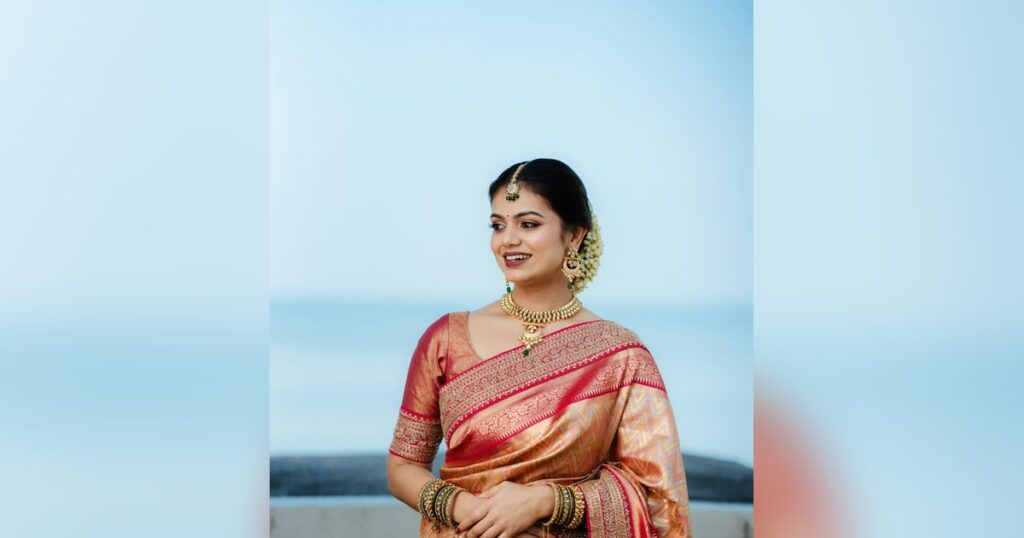
A mysore silk saree feels different from a Kancheepuram, and both feel different again from a Chanderi, even though all three are silk. The differences come from region, yarn and weaving method rather than from price. This guide walks through the silk weaves worth knowing, how to verify that what you are buying is genuine, and how to match a weave to the occasion you actually have in mind.
Key Takeaways
- Region decides character. Karnataka silk is smooth and fluid, Tamil Nadu silk is heavy and structured, and central Indian weaves are light and sheer.
- Authenticity can be checked. The Silk Mark label, the burn test and the zari test between them will settle almost any doubt.
- Weight is the practical filter. Match the weight of the weave to the length of the occasion before you look at colour.
What Makes Silk Behave The Way It Does
Silk is a protein fibre produced by silkworms, and the way it is reeled decides almost everything about the finished cloth. Long continuous filaments produce smooth, lustrous fabric. Shorter broken fibres produce a textured, matte cloth that behaves very differently on the body.
Mulberry silk accounts for most Indian production and gives the smooth, high sheen surface people picture when they think of silk. Wild silks such as tussar are coarser, warmer in tone and considerably less shiny, which is a difference in character rather than in quality.
The sericulture industry in India is large and regionally specialised, and Karnataka alone produces a substantial share of the country mulberry silk. That concentration is why certain weaves are so closely tied to particular states.
Weight is the other variable and the one that matters most day to day. Silk weight comes from yarn thickness and from how much zari is woven in. A heavy wedding saree can weigh several times what a light everyday silk does, and that difference decides whether you enjoy a six hour function or endure it.
Drape follows from both. Smooth mulberry silk with minimal zari falls close to the body and pleats narrowly. Heavily zari worked silk stands away, holds structure and creates the sculptural silhouette associated with South Indian wedding wear.
Understanding these three variables, fibre type, weight and zari content, lets you predict how an unfamiliar weave will behave before you ever touch it. That is most of what this guide is for.
There is a fourth variable that rarely appears on a label, which is whether the saree was woven on a handloom or a power loom. Handloom silk carries tiny irregularities in the weave, a slightly uneven selvedge and a softness that comes from the weaver adjusting tension by feel. Power loom silk is perfectly uniform, which many buyers read as higher quality when it is simply mechanical.
Neither is dishonest, and power loom silk can be excellent value. What matters is knowing which you are paying for. A handloom silk takes days on the loom and supports a weaving household directly, and that is reflected in the price. When a listing advertises handloom at a price only a machine could produce, the claim is doing more work than the cloth is.
The Regional Weaves Worth Knowing
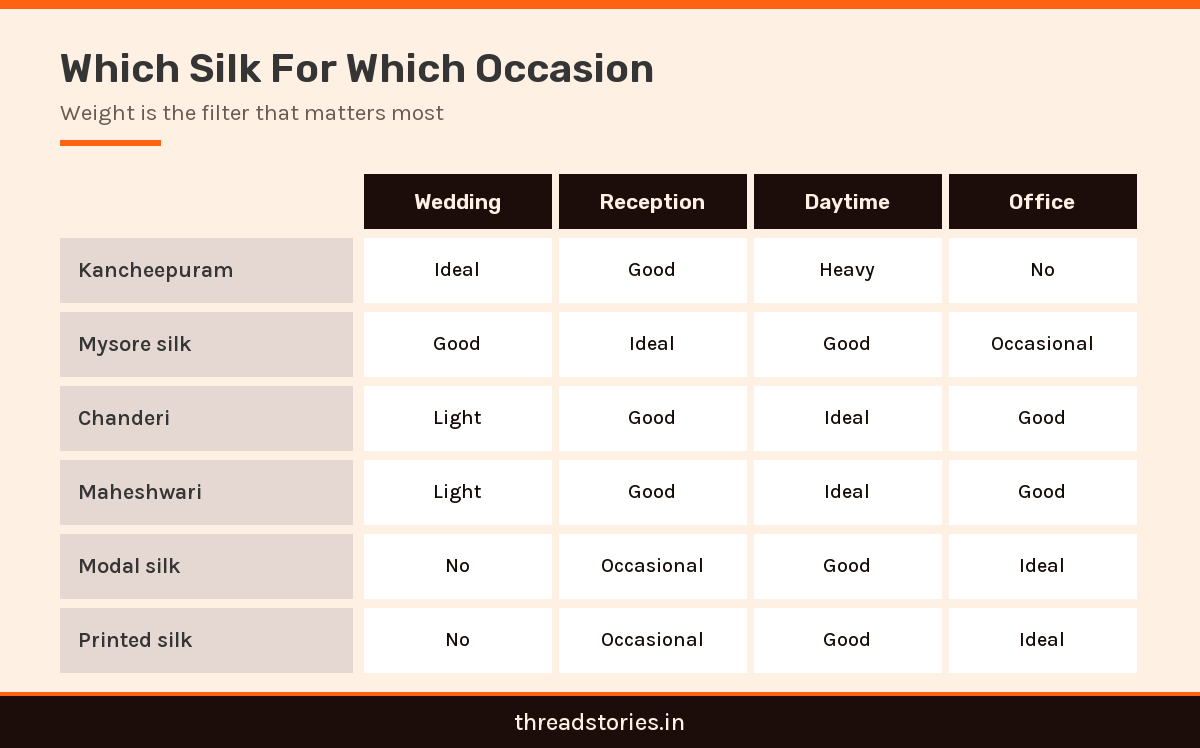
Indian silk is organised by region rather than by fibre, and each weaving centre solved a different problem. Five clusters cover most of what you will encounter.
Karnataka: Mysore and Bangalore silk
Karnataka silk is known for a smooth, fluid finish and a restrained use of zari, usually confined to the border and pallu. Mysore silk is light enough to wear through a full day and formal enough for a wedding, which is an unusually broad range for a single weave. The Mysore silk range tends to lead with plain grounds and contrast borders, which is the classic treatment. Bangalore silk is close in character and often carries surface work such as kantha stitching.
Tamil Nadu: Kancheepuram
Kancheepuram silk is the heaviest of the common weaves and the most structured. Body and border are woven separately and joined with an interlocked technique, which is why the border can carry so much weight without distorting the body. A Kancheepuram drape is a wedding and milestone saree rather than an everyday one, and the weave carries a geographical indication tying the name to the region.
Central India: Chanderi and Maheshwari
Madhya Pradesh produced two of the lightest silk weaves in India. Chanderi is sheer with a glossy transparency, usually combining silk and cotton, and it suits daytime functions in heat. Maheshwari, from the town of Maheshwar on the Narmada, is slightly heavier with distinctive reversible borders and fine stripes. Both sit at the comfortable end of festive silk.
Blended and everyday silks
Modal silk sits slightly outside the heritage weaves and deserves its own note, because it solves a problem none of the others do. Modal is a cellulose fibre, usually blended with silk, producing a cloth with real sheen and an unusually fluid fall at a fraction of the cost and weight. It washes more easily than pure silk and creases less, which makes it the only genuinely everyday option in this family.
Printed silks work similarly. Rather than relying on woven zari for interest, the design sits on the surface, which keeps the cloth light and the price moderate. The printed silk options are worth considering if you want silk in regular rotation rather than reserved for occasions.
Two more weaves are worth recognising. Tant silk is a Bengal weave, crisp and comparatively light, with a finish that suits daytime wear. Zari mul mul combines the featherlight character of mul cotton with fine zari detailing, producing something that reads festive while weighing almost nothing.
How To Verify Silk Is Genuine
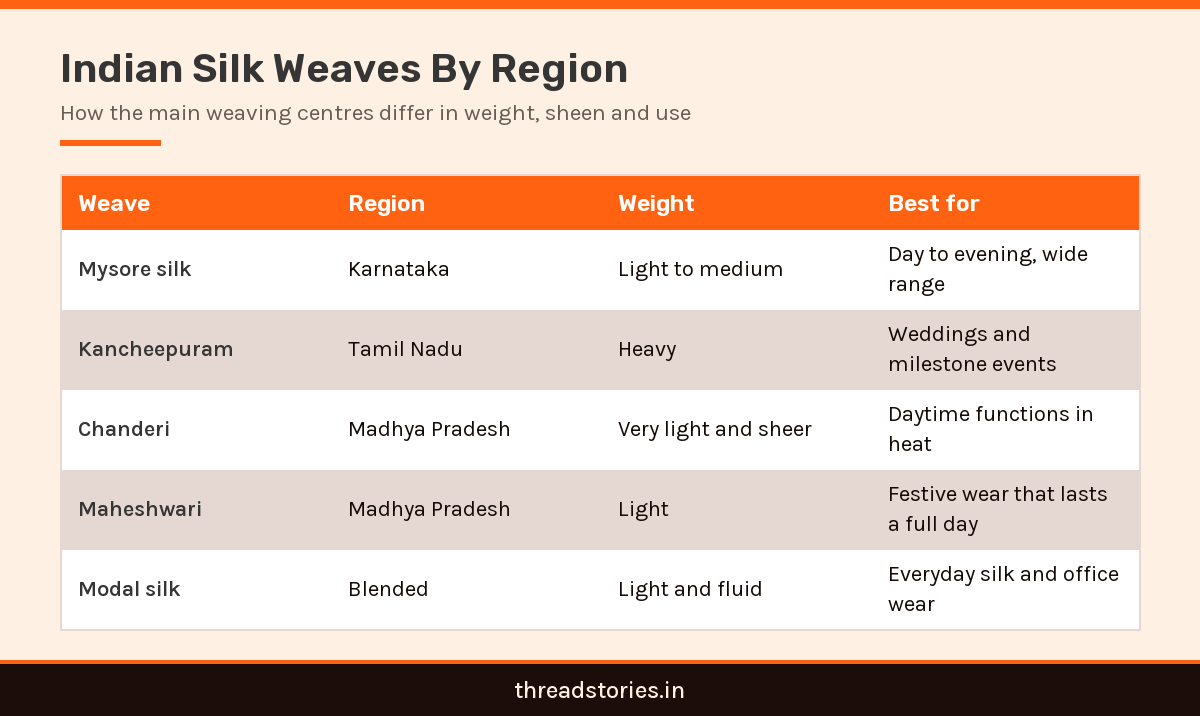
Silk is the most commonly imitated saree fabric, and three checks between them settle almost every case.
The first is the Silk Mark label, issued under the Central Silk Board. It is a hologram tag confirming the fabric is pure natural silk. Its absence does not prove a saree is fake, since many genuine handloom weavers do not register, but its presence is meaningful.
The second is the burn test, done on a single thread pulled from the fringe. Natural silk burns slowly, smells of burnt hair and leaves a brittle black ash you can crush to powder. Synthetic melts, smells chemical and leaves a hard bead. Never do this on the body of a saree.
The third concerns zari. Real zari is silver thread wrapped around a silk core and finished with gold. Scratch a small section gently at the edge. Genuine zari reveals a reddish silver underneath, while tested zari shows white or plastic thread. Most modern sarees use tested zari, which is perfectly legitimate and far cheaper, but it should be priced accordingly.
Price is the fourth signal and the bluntest. Pure silk with real zari has a raw material floor below which no honest seller can go. A wedding weight saree offered at a fraction of the usual range is telling you something about the fibre or the zari, whatever the listing claims.
Where possible, buy from sellers who will name the weave, the region and the zari type without being pushed. That willingness to be specific is the single best proxy for honesty in this category.
Some weaves also carry a geographical indication, a legal protection registered through the Indian intellectual property office that restricts a name to cloth actually produced in its region. Kancheepuram and Chanderi both hold one. It does not guarantee quality, but it does mean the name has a defensible meaning rather than being a loose description.
Be sceptical of the word art silk, which appears frequently and sounds reassuring. It is short for artificial silk and means a synthetic such as viscose or rayon. There is nothing wrong with the fabric itself, and it can be beautiful, but it is not silk and should never be priced as though it were.
Matching A Silk Weave To The Occasion
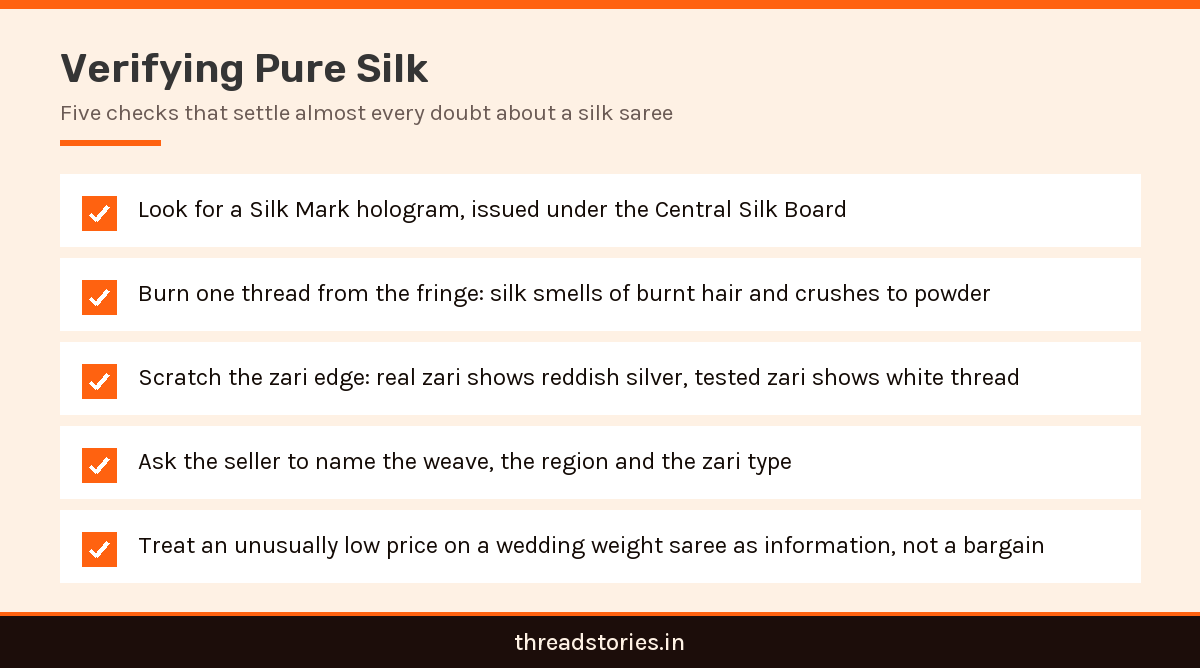
Most disappointment with silk comes from a weight mismatch rather than a bad saree. The rule is simple. The longer the event and the warmer the setting, the lighter the weave should be.
For weddings where you are a principal guest or family, a heavy Kancheepuram or a substantial zari woven silk is appropriate and expected. These are sarees designed to be photographed and to hold their shape through a long ceremony.
For receptions and evening functions where you will be standing and moving, a mid weight Mysore or Bangalore silk gives presence without exhaustion. This is the most commonly under used category and usually the right answer.
For daytime functions, festivals and anything outdoors in heat, move to Chanderi, Maheshwari or a light modal silk. These carry the sheen of silk at a fraction of the weight.
For office wear and everyday silk, modal and printed silks are the practical choice. They wash more easily, crease less and do not demand the care that a zari heavy saree does.
For gifting, mid weight is almost always the safe answer. A very heavy saree may sit unworn for years, while a lighter silk in a wearable colour gets used. Gifting a weave someone will actually wear is more generous than gifting the most expensive option available.
Colour, Border And Pallu
Silk carries colour more intensely than cotton because the fibre reflects light, so a shade that looks moderate in cotton reads considerably stronger in silk.
Traditional South Indian silk favours strong contrast between body and border, with combinations such as green and pink or mustard and purple that would look bold in any other fabric and read as classic here. Those pairings are worth trusting.
Tonal silk, where border and body sit close in shade, reads modern and understated. It photographs more softly and suits anyone who finds traditional contrast too loud for an office or a small gathering.
The pallu carries the most design weight and is what people see when you turn. On a plain bodied saree a richly woven pallu does all the work, which is why that construction is so common and so effective.
Border width sets the formality. A narrow border keeps a silk saree wearable for an ordinary evening. A broad zari border, particularly above four inches, moves the same colour firmly into wedding territory.
For a blouse, either match the border colour or pull a secondary shade from the pallu. Our guide to blouse styles covers neckline and sleeve choices in detail, and aari work blouses pair particularly well with plain bodied silk.
Motif scale is worth noticing as well, because it changes how a saree reads across a room. Small repeated butta motifs scattered across the body give an even, understated texture that suits a smaller frame. Large motifs and broad temple borders create drama and carry better at a distance, which is why they dominate wedding weaves.
One practical colour note. Silk photographs brighter than it appears in the hand, particularly under the warm lighting used at most Indian functions. If you are choosing specifically for an event that will be photographed heavily, a shade slightly deeper than your instinct usually reads better in the final images.
Caring For Silk So It Lasts Decades
Silk is durable but unforgiving of specific mistakes, and almost all serious damage comes from four causes: water marks, sunlight, folding and moisture.
Cleaning
Dry clean silk sarees rather than washing them, particularly anything with zari. Water leaves visible rings on silk and tarnishes metallic thread. If a spill happens, blot immediately with a dry cloth and take the saree for cleaning rather than attempting to treat the spot at home, which usually spreads the mark.
Limit dry cleaning to once or twice a year even for a saree in regular use. The solvents are harsh, and airing a silk saree in shade after wearing removes most odour without any chemical exposure at all.
Storage
Wrap silk in a cotton or muslin cloth rather than plastic. Plastic traps moisture, and trapped moisture on silk produces both mildew and permanent yellowing. Never store silk in direct contact with a wooden shelf, since untreated wood releases acidity that stains.
Refold every three to four months along a different line. Zari cracks where it is folded repeatedly, and that cracking is irreversible. This single habit does more for the life of a silk saree than anything else on this list, and it takes ten minutes twice a year.
Keep silk away from direct sunlight in storage as well as on the line. Light fades dye and weakens the fibre over years rather than months, so a saree stored near a window will visibly differ from one kept in a dark cupboard. Natural repellents such as neem leaves or dried cloves work better than chemical mothballs, which leave an odour that is difficult to remove from silk.
Wearing and handling
Put jewellery, perfume and deodorant on before the saree rather than after. Alcohol based sprays stain silk permanently and the mark will not lift, while sharp jewellery edges catch and pull threads, which shows immediately on a smooth surface.
Use safety pins sparingly and always through the inner layers. Every pin leaves a small hole, and on fine silk those holes accumulate visibly around the shoulder. A saree pin with a broad flat back distributes the strain far better than an ordinary safety pin does.
Buying Silk Online Without Anxiety
Silk is the category where online buying feels riskiest, mostly because the stakes are higher and the colour is harder to judge.
Read the description before the photograph. A seller who states the weave, the region, the zari type and the weight is giving you information. A listing that says only pure silk saree is giving you a claim.
Check the measurements. Silk sarees typically run five and a half to six and a half metres, and blouse piece length varies. If you drape with extra pleats or you are tall, this decides where the pallu falls.
Look for daylight photographs and more than one angle. Silk shifts dramatically under different lighting, and a saree shot under warm studio lights will read quite differently at an afternoon function.
Understand the return position before ordering rather than after. Cloth is a category where colour and drape are genuinely hard to judge on a screen, and a seller confident in their stock will say so plainly.
Finally, order ahead. Allowing two weeks leaves room for a blouse to be stitched and for any small adjustment. The full silk collection is organised by weave rather than by colour for exactly this reason, and our team will answer questions about a specific piece before you commit.
Building A Small Silk Collection
Silk does not need to be collected in volume. Four well chosen sarees will cover a decade of occasions for most people.
The first should be a mid weight silk in a colour you genuinely like, with a moderate border. This is the saree that goes to receptions, family functions and anything where you want presence without commitment.
The second should be a light festive weave, a Chanderi, a Maheshwari or a tissue drape, for daytime events and warm weather. This will be worn more often than the heavier pieces.
The third is the occasion saree, and this is where a heavy Kancheepuram or a substantial zari silk belongs. Buy it once, buy it well, and accept that it will be worn a handful of times a decade.
The fourth should be an everyday silk, a modal or a printed weave, that washes easily and can be worn to an office without ceremony. This is the piece most collections lack and the one that gets used most.
Beyond those four, add only when a genuine gap appears. Silk sarees are inherited, borrowed and passed along, and most families accumulate more than they buy. If you would like help identifying which of the four you are missing, the team behind the collection is happy to talk it through.
Blouses deserve a line in any silk plan, because they decide how often a saree actually leaves the cupboard. A silk saree without a fitting blouse tends to stay folded, whatever your intentions. Keeping one well fitted blouse in a neutral that suits two or three of your silks removes that obstacle entirely.
Think about inheritance too, since silk outlasts most of the people who buy it. A saree stored properly and refolded twice a year will pass to the next generation in wearable condition, while one left in plastic in the same cupboard will not. Of everything in this guide, storage is the part that decides whether a silk saree is a purchase or an heirloom.
Conclusion
Silk is easier to buy once you read it by region and weight rather than by price. A mysore silk saree gives range and comfort, Kancheepuram gives ceremony and structure, and the central Indian weaves give festive sheen without the burden. Verify with the Silk Mark, the burn test and the zari scratch, match weight to occasion before colour, and store folded in cotton with a refold twice a year. Explore the ThreadStories silk collection to compare these weaves side by side.
Frequently Asked Questions
What makes a mysore silk saree different from a Kancheepuram?
Weight and construction. Mysore silk is lighter with restrained zari and a fluid drape. Kancheepuram is heavy, structured and has its border woven separately then interlocked.
How can I tell if a silk saree is pure silk?
Burn a single thread from the fringe. Pure silk smells of burnt hair and crushes to a brittle powder. Synthetic melts, smells chemical and leaves a hard bead.
What is the Silk Mark label?
A hologram tag issued under the Central Silk Board confirming the fabric is pure natural silk. Its presence is meaningful, though many genuine handloom weavers do not register.
What is the difference between real and tested zari?
Real zari is silver thread wrapped on a silk core and gold finished. Tested zari uses cheaper substitutes. Scratch the edge: real zari shows reddish silver underneath.
Which silk saree is best for a summer wedding?
A Chanderi or Maheshwari for daytime functions, since both are light and sheer. Save a heavy Kancheepuram for evening ceremonies in cooler or air conditioned settings.
Can silk sarees be washed at home?
Better not, particularly with zari. Water leaves visible rings on silk and tarnishes metallic thread. Dry clean once or twice a year and air in shade between wearings.
How should I store a silk saree?
Wrapped in cotton or muslin, never plastic, and away from direct contact with wooden shelves. Refold along a different line every three to four months to stop zari cracking.
Is modal silk real silk?
Modal is a cellulose fibre often blended with silk, giving a fluid drape at lower cost. Check the listing for the blend ratio rather than assuming it is pure silk.
How many silk sarees should I own?
Four covers most calendars. One mid weight for receptions, one light festive weave, one heavy occasion saree and one everyday silk you can wear without ceremony.
What blouse suits a plain bodied silk saree?
A worked or embroidered blouse, since the saree leaves room for it. Browse the aari work blouse pieces for hand embroidered options that pair well with silk.