
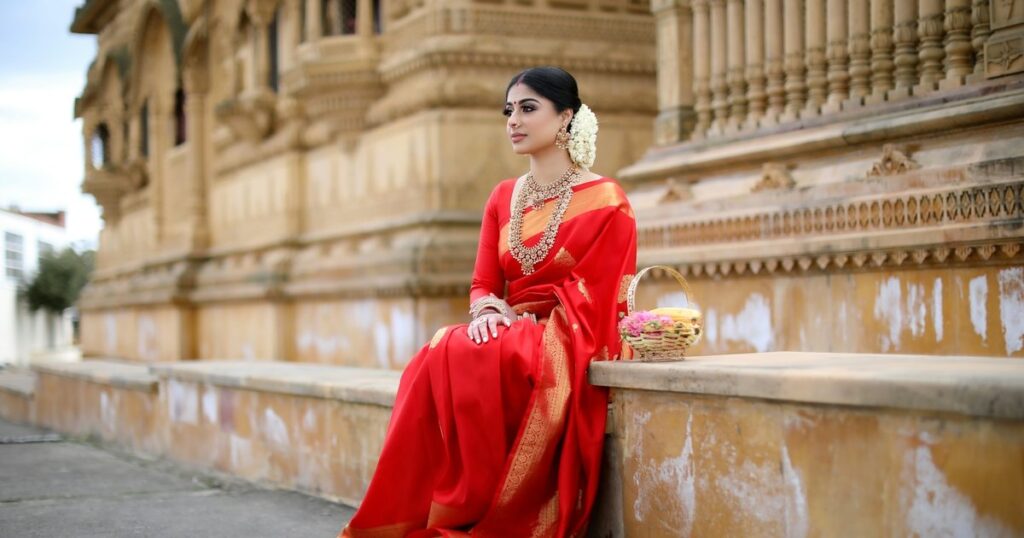
A banarasi silk saree is the piece most Indian families treat as an heirloom rather than a purchase. The weight, the density of the zari and the Mughal influenced motifs make it instantly recognisable. This guide covers what actually defines the weave, the four traditional types, how to tell a handloom piece from a power loom copy, and how to store one so it survives to be passed on.
Key Takeaways
- The weave is defined by dense brocade work in zari, usually in Mughal influenced floral and foliate motifs.
- There are four recognised traditional types, separated by the fibre and the technique rather than by colour.
- Handloom and power loom versions look similar in photographs and behave completely differently over twenty years.
What Defines The Weave
The defining feature is brocade. Metallic zari thread is woven into the silk as the cloth is made, creating raised patterns that are part of the structure rather than embroidery applied afterwards.
The motifs carry a recognisable vocabulary. Floral and foliate designs, intertwining vines, a border of upright leaf shapes and small repeated buttas across the body all trace back to Mughal era design. That shared language is why a banarasi piece is identifiable across colours.
Weight follows from the zari. Because the metallic thread is dense and continuous, these sarees are among the heaviest silk drapes made in India, which is what gives them their structured fall and their reputation as occasion wear rather than everyday wear.
The weaving itself is slow. A heavily worked saree can occupy a loom for weeks, with multiple weavers working the same piece, and the most intricate designs require a jacquard or a traditional punch card setup to control the pattern.
That labour is the reason for the price range, and it is also the reason the category attracts so many imitations. A power loom can reproduce the appearance in hours rather than weeks, which creates a very wide gap between two sarees that photograph almost identically.
The Four Traditional Types
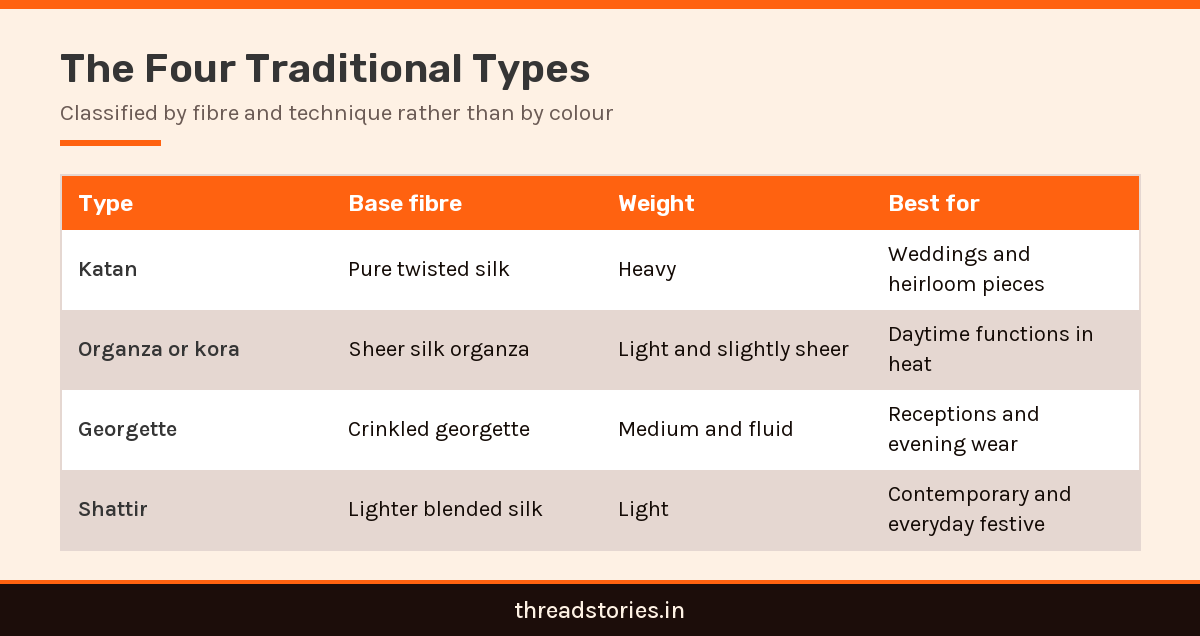
Classification is by fibre and technique rather than by colour or motif, and knowing the four makes a listing far easier to read.
Pure silk, often called katan, is the classic. Twisted silk filaments produce a smooth, durable cloth with a firm hand. This is the version most associated with weddings and the one most likely to be kept for decades.
Organza with zari, sometimes called kora, is considerably lighter and slightly transparent, with zari work sitting against a sheer ground. It suits warmer weather and daytime functions where a katan would be uncomfortable.
Georgette based versions have a crinkled texture and a fluid, falling drape rather than a structured one. They read modern, move beautifully and are far easier to carry through a long evening.
Shattir is the least known of the four and is used for more contemporary, lighter designs. It is the most wearable for anyone who wants the aesthetic without the weight, though it is much less commonly stocked.
A fifth term you will meet is tanchoi, which describes a technique rather than a fibre. Tanchoi weaving produces dense patterning with no floats on the reverse, giving a smooth back and an unusually rich surface.
Telling Handloom From Power Loom
This is the single most useful skill in this category, because the price difference is large and the visual difference in a photograph is small.
Turn the saree over and look at the reverse. On a genuine handloom brocade you will see floats, the loose threads carried between motifs, and they will be slightly irregular. A power loom reverse is neat, even and often machine trimmed.
Look for small imperfections on the front. Hand weaving produces tiny variations in motif spacing and in the tension of the zari. Perfect repetition across six metres is a sign of mechanical production, not of care.
Check the zari itself. Real zari is silver thread wrapped on a silk core with a gold finish, and a gentle scratch at the edge reveals reddish silver beneath. Tested zari shows white or plastic thread. Most modern sarees use tested zari legitimately, but it should be priced as such.
Feel the weight and the hand. Genuine silk has a cool, slightly grainy feel and a distinctive rustle. Synthetic brocade feels slippery, warms quickly against the skin and hangs with a limp fall rather than a structured one.
If you are buying at distance, ask the seller directly whether the piece is handloom and what zari it uses. A seller who answers precisely is worth more than any certification, and the silk collection at ThreadStories is described weave by weave for that reason.
Styling And Occasions
A heavy brocade saree carries its own presence, and the most common styling mistake is competing with it.
Keep the blouse simple when the saree is densely worked. A plain silk blouse in a colour drawn from the border lets the weave do the work. Save heavily embroidered blouses for plain bodied sarees that leave room for them.
Jewellery should be chosen the same way. Traditional gold works naturally against zari, but one substantial piece is usually enough. A full set alongside a dense brocade becomes visually crowded in a way that photographs badly.
For draping, the structured fall of the fabric suits neat, firmly pinned pleats. Because the cloth is heavy, a well fitted petticoat with a strong waist cord matters more here than with any lighter weave.
On occasions, this is wedding and milestone territory. For lighter events, an organza or georgette version gives the same visual language at a fraction of the weight. Our blouse styling guide covers neckline choices that suit heavy bordered silk.

Storing A Saree You Intend To Keep
These sarees are bought to last decades, and almost all long term damage comes from storage rather than from wearing.
Wrap in cotton or muslin, never plastic. Trapped moisture causes both mildew and yellowing on silk, and the damage usually appears along the folds first where air cannot circulate.
Refold along a different line every three to four months. Zari cracks where it is folded repeatedly, and once the metallic thread breaks the damage cannot be reversed. This is the most important habit on the list.
Keep silk away from direct contact with wooden shelves. Untreated wood releases acidity that stains, and a simple cotton lining between shelf and saree prevents it entirely.
Use natural repellents such as neem leaves or dried cloves rather than chemical mothballs, which leave an odour that is very difficult to remove from silk. Air the saree in shade once or twice a year rather than dry cleaning it unnecessarily.
Dry clean only when genuinely needed, perhaps once a year even for a piece in regular use. Solvents are harsh on both silk and zari, and over cleaning does more cumulative damage than careful wearing ever will.
Hanging is the one storage method to avoid entirely. A heavy brocade saree hung for months stretches under its own weight, and the distortion shows at the shoulder of the pallu where the strain concentrates. Flat folded storage in a drawer or on a shelf is always the better option for anything this heavy.
Keep a note of when you last refolded each saree. Families who own several silk pieces almost always lose track, and the one that sat untouched for three years is the one that comes out with cracked zari along every fold. A line in a phone note twice a year is enough to prevent it.
Conclusion
A banarasi silk saree is a long term purchase rather than a seasonal one, so the checks are worth making properly. Learn the four types, read the reverse for floats, scratch test the zari and buy from someone willing to be specific about what they are selling. Then store it wrapped in cotton and refold it twice a year. Explore the ThreadStories silk range to compare handloom silk weaves before you decide.
Frequently Asked Questions
What makes a banarasi silk saree different from other silk?
Dense brocade work in metallic zari woven into the cloth as it is made, using Mughal influenced floral and foliate motifs. The zari is structural rather than embroidered on.
What are the four types of banarasi saree?
Katan in pure twisted silk, organza or kora which is sheer and light, georgette with a crinkled fluid drape, and shattir which is lighter and more contemporary.
How can I tell a handloom banarasi from a power loom one?
Check the reverse for irregular floats between motifs and look for slight variation in motif spacing. Power loom pieces are perfectly even and neatly finished behind.
What is tanchoi weaving?
A technique producing dense patterning with no loose floats on the reverse, giving a smooth back and a rich surface. It describes the method rather than the fibre.
Is tested zari a sign of a fake saree?
No. Tested zari uses cheaper substitutes for silver and is entirely legitimate. It simply should be priced lower than real zari, which is silver wrapped on silk.
Can a banarasi saree be worn in summer?
Choose organza or georgette versions for warm weather. A heavy katan is genuinely uncomfortable in heat and is better kept for cooler evening ceremonies.
How should I store a heavy brocade saree?
Wrapped in cotton or muslin, never plastic, away from wooden shelves. Refold along a different line every three to four months to stop the zari cracking.
Which blouse suits a heavily worked brocade saree?
A plain silk blouse in a colour drawn from the border. Dense brocade already carries the detail, so an embroidered blouse competes rather than complements.
How often should a silk brocade saree be dry cleaned?
Roughly once a year, even with regular wearing. Solvents are harsh on silk and zari, and airing in shade removes most odour without any chemical exposure.
Does ThreadStories stock banarasi sarees?
The current silk range focuses on Mysore, Kancheepuram, Chanderi, Maheshwari and modal weaves. Write to the team to ask about specific weaves or sourcing.