
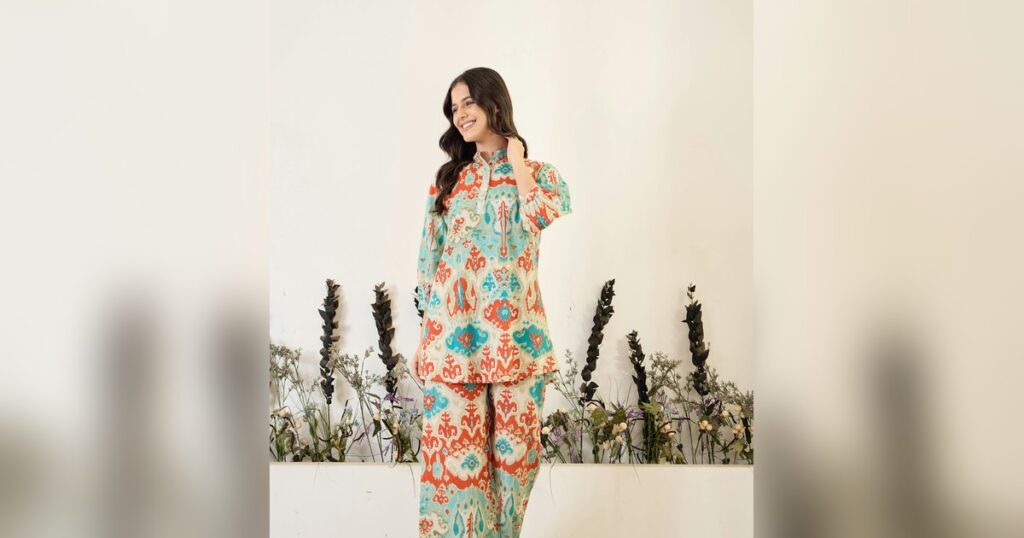
A cotton kurta set for women is the most used item in most Indian wardrobes and the least thought about. It goes to work, to family lunches, to airports and to festivals, often in the same week. This guide covers the silhouettes worth knowing, how chikankari differs from other embroidery, how to judge fabric and fit before you buy, and how to build a small set that genuinely covers a year.
Key Takeaways
- Silhouette decides more than colour. A straight kurta, an anarkali and a short kurti suit different days and different body shapes entirely.
- Chikankari is hand embroidery from Lucknow, not a print. The stitch texture is what separates a real chikankari piece from a machine copy.
- Fit at the shoulder and the armhole matters more than any other measurement. Everything else can be altered cheaply.
Why The Kurta Set Became The Default
The kurta set solved a problem that neither a saree nor western clothing solved for most Indian women, which is how to dress quickly, modestly and comfortably for a day that might contain several very different rooms. It requires no draping, it tolerates heat, and it reads as appropriate almost everywhere.
The kurta itself is an old garment, but the modern set of kurta, bottom and dupatta as a coordinated unit is relatively recent. What changed is the expectation that the three pieces should be bought together and designed to work together, which removed the daily decision of what goes with what.
Cotton became the default fabric for the same reason it dominates saree wardrobes. It breathes, it washes at home and it survives an Indian summer. Synthetic kurtas look identical in a photograph and feel entirely different after four hours in real heat.
The practical result is that most women own more kurta sets than anything else and wear perhaps a third of them. The unworn ones almost always fail on fit or on fabric weight rather than on design, which is why those two things take up most of this guide.
There is also a range question. A wardrobe of five well chosen sets covers more situations than fifteen bought impulsively, because the five can be recombined. That recombination only works if the pieces share a colour logic, which is the last section of this guide.
It helps to see the kurta set as three independent decisions rather than one purchase. The top decides the silhouette and carries the detail. The bottom decides the line and how formal the outfit reads. The dupatta, when worn at all, decides how much colour is in play. Buying them as a fixed unit is convenient, but it also locks three decisions together and is the main reason so many sets end up worn once as sold and then never again.
That unbundling is also how a modest wardrobe starts to look larger. A single straight kurta paired with a white palazzo, then a black straight pant, then jeans, reads as three different outfits to anyone watching. Very few people notice a repeated top. Almost everyone notices a repeated complete set, which is an argument for spending on versatile kurtas and staying plain on bottoms.
The Silhouettes Worth Knowing
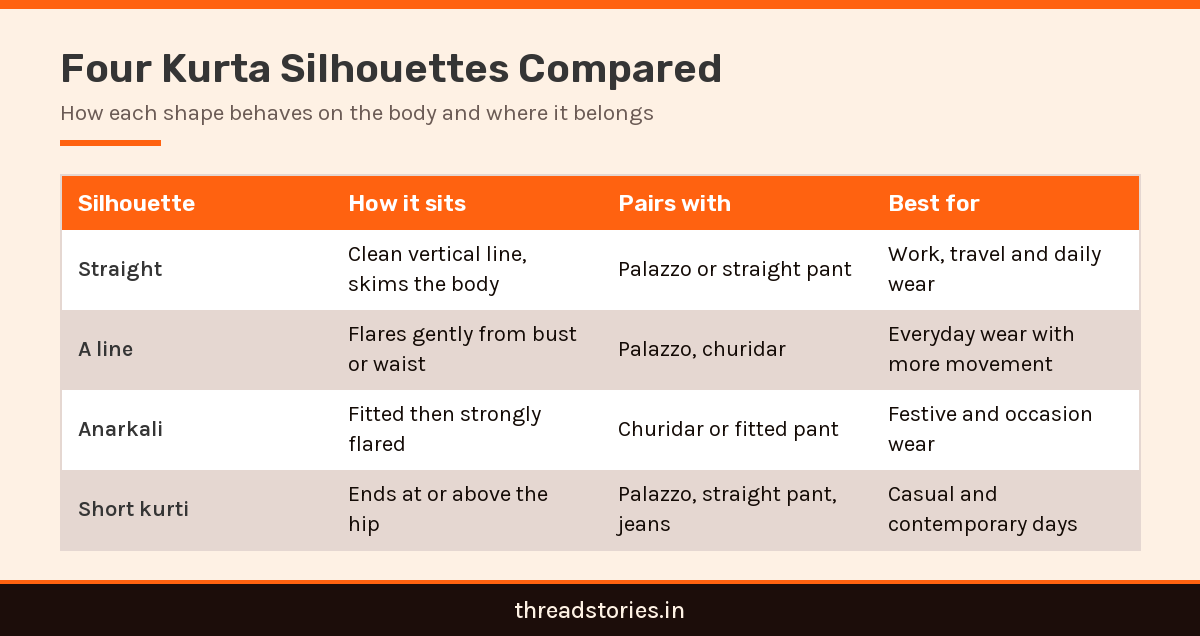
Four shapes cover almost everything on the market. Knowing how each one behaves on the body removes most of the guesswork from buying online.
Straight and A line kurtas
The straight kurta falls in a clean vertical line from shoulder to hem. It is the most versatile shape, works on nearly every body type, and is the safest first purchase. The A line flares gently from the bust or waist, which adds movement and skims rather than clings. Both suit work, travel and everyday wear, and both take either a palazzo or a straight pant underneath. The everyday kurta range leans towards these two shapes for exactly that reason.
Anarkali and flared sets
The anarkali is fitted through the bust and then flares dramatically, usually from just under the chest. It creates length, which flatters shorter frames, and it moves beautifully, which is why it dominates festive wear. The trade off is volume. An anarkali is warm, it needs more fabric, and it is harder to sit in on a working day. Treat it as an occasion silhouette rather than a daily one.
Short kurtis and layered sets
A short kurti ends at or above the hip and reads far more casual and contemporary. It pairs naturally with palazzos, straight pants and even jeans, which makes it the most flexible piece in a young wardrobe. The short kurti options work well for anyone who wants ethnic detailing without a full traditional silhouette. Layering a shrug or jacket over a short kurti extends it into cooler months without buying anything new.
Matching the bottom to the shape
The bottom is half the silhouette and rarely gets half the thought. A straight kurta accepts almost anything, which is why it is so easy to wear. An A line sits best over something narrow, because volume on both halves reads shapeless. An anarkali needs a fitted churidar or a slim pant, since a palazzo underneath a heavy flare creates more fabric than any frame can carry.
Short kurtis invert the rule entirely. Because the top is cropped, the bottom becomes the dominant piece, and a wide palazzo or a strongly printed pant works well. This is the one combination where a bold bottom is the better choice, and it is worth using a few of the ready to wear pant options to test that before committing to a full set.
Chikankari And How To Recognise It
Chikankari is hand embroidery associated with Lucknow, worked in white or pale thread on light fabric. It is not a print, and the difference is visible and tactile once you know what to look for.
Turn the garment inside out. Real chikan embroidery shows a worked reverse, with visible thread paths and sometimes a deliberate shadow effect where the stitch sits behind the cloth. A printed imitation shows nothing on the reverse at all.
Feel the surface next. Hand chikankari has slight relief, because the thread sits on and through the fabric rather than being applied to it. Run a palm across the motif. If it is completely flat, it is printed or heavily machine worked.
Look at repetition. Hand work varies. Two flowers on the same kurta will be similar but never identical, and that irregularity is the signature of a person rather than a machine. Perfect repetition across a garment is the clearest sign of machine embroidery.
Quality within genuine chikankari varies enormously too, mostly by stitch density and stitch variety. A simple piece may use two or three stitches. A fine piece uses many, including the raised and net like stitches that take the most skill. Browsing the chikankari collection side by side makes those differences obvious quickly.
The craft carries real economic weight, which is worth knowing when you compare prices. Chikankari supports tens of thousands of artisans around Lucknow, most of them women working from home, and a hand worked kurta represents days rather than hours of labour. When a listing offers dense hand embroidery at the price of a plain kurta, the arithmetic simply does not work, and what you are buying is almost certainly machine embroidery.
Colour is another useful signal. Traditional chikankari is white thread on white or pale cloth, because the effect depends on texture and shadow rather than contrast. Bright thread on dark fabric is a modern variation rather than a fault, but it is worth recognising that the classic version is the one that shows stitch quality most clearly, since there is no colour to hide behind.
Care sits alongside recognition. Hand embroidery is held by thread that sits proud of the cloth, so it catches on zips, bag straps and washing machine drums. A chikankari kurta washed by hand and dried in shade will outlast one that goes through a gentle machine cycle by several years, and the difference shows first at the densest areas of work around the neckline.
Judging Fabric And Fit Before You Buy
Fabric weight decides comfort more than fibre content does. A heavy cotton in peak summer is unpleasant regardless of how pure it is, and a very light cotton needs lining or it becomes transparent under sunlight.
Reading the fabric
Mul and voile cottons are the lightest and suit real heat, though they usually need a slip underneath. Standard cotton and cotton blends sit in the middle and handle most of the year. Cotton silk and chanderi add a faint sheen and work for occasions. If a listing does not name the fabric beyond the word cotton, assume mill woven and mid weight.
The measurements that matter
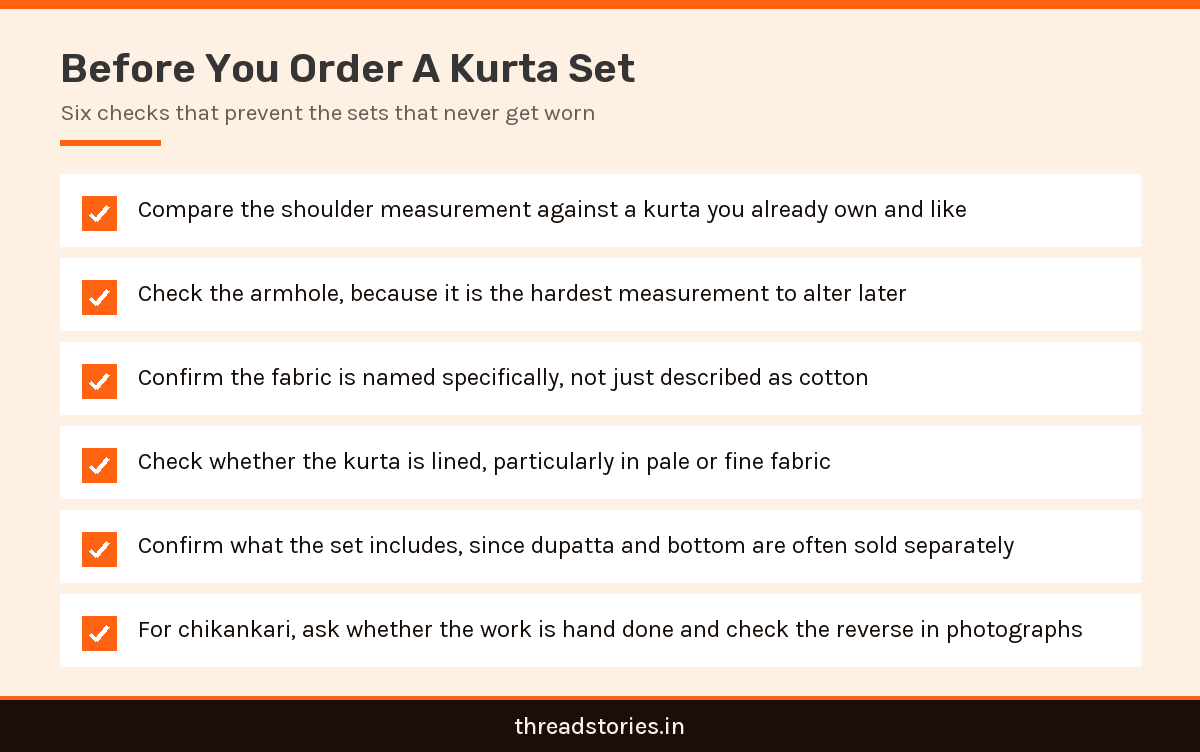
Shoulder width and armhole are the two that decide whether a kurta looks right, and both are expensive to alter. Bust, waist and length are all straightforward for a tailor to adjust. When ordering online, compare shoulder measurement against a kurta you already own and like rather than against your body measurement, which is far less reliable.
Length is worth a separate thought because it changes how formal a kurta reads. Mid thigh is casual, knee length is the everyday standard, and calf length reads traditional and more formal. Sleeve length does similar work. A three quarter sleeve is the most versatile, a full sleeve is the most formal, and a short sleeve keeps everything relaxed.
Lining and finishing
Lining is the detail that separates a well made kurta from a cheap one, and photographs never show it. Pale cotton, voile and fine chikankari all become sheer in daylight, and a properly lined garment solves that without you needing a slip. Check whether lining is mentioned, and if it is not, assume there is none.
Look at the finishing on the side slits and the hem as well. A double stitched or bias bound edge will survive years of washing. A single overlocked edge will fray, usually starting at the slit, which is the point under the most stress when you sit down. On a kurta you intend to wear weekly, that seam is worth more attention than the print on the front.
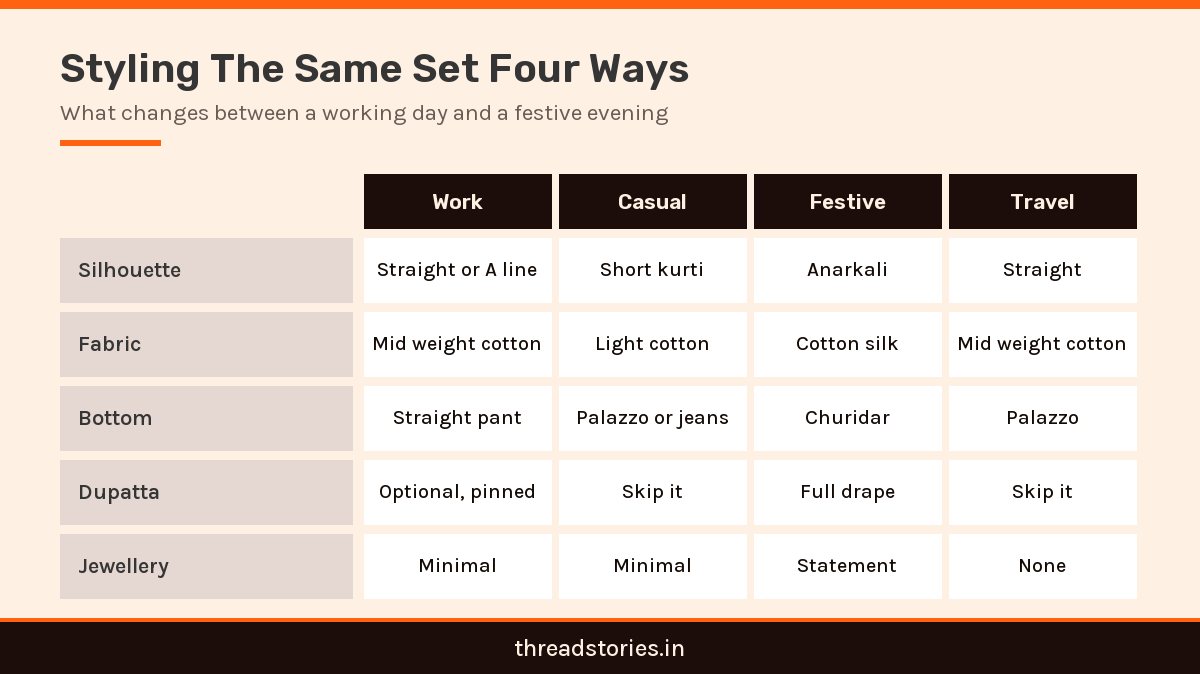
Styling For Work Without Looking Overdressed
The working kurta set has a narrow target. It needs to read professional without reading like occasion wear, and most mistakes come from too much embellishment rather than too little.
Choose straight or A line shapes in solid colours, small prints or restrained chikankari. Avoid heavy sequin work, wide flares and anything with a long trailing dupatta, all of which are impractical in an office and read as festive.
Bottoms should be simple. Straight cotton pants or narrow palazzos in a matching or neutral shade keep the line clean. Churidars work but crease heavily through a day of sitting.
The dupatta is optional for work and often better left off. When you do wear one, keep it narrow and pinned at the shoulder rather than draped loose, which stops it becoming something you manage all day.
Colour is where a working wardrobe succeeds or fails. Mid tones such as indigo, olive, rust, grey and mustard repeat well without being noticed, hide creasing, and combine with each other. Very pale shades show everything and very bright shades become memorable in a way that limits how often you can wear them.
Footwear finishes the decision and is often what tips an outfit from professional to festive. Flat sandals, closed loafers and simple mules keep a kurta set firmly at work. Embellished or mirrored footwear moves the same outfit towards occasion wear, which is useful to know when you want one set to do both jobs on the same day.
One practical note on fabric for offices specifically. Air conditioning changes what works. A light cotton that is perfect for a commute can feel thin in a cold meeting room, so a kurta with a lining or a light shrug kept at your desk solves a problem that most styling advice ignores entirely.
Festive And Occasion Styling
Festive dressing asks the opposite question. Here the set should be memorable, and the practical constraints of an office no longer apply.
The anarkali is the natural festive silhouette because volume reads as celebration. A flared festive set with a fitted bodice creates length and movement, and it photographs well, which matters more at a wedding than anyone admits.
Fabric should carry some light. Cotton silk, chanderi and fine cotton with zari or thread work all lift a silhouette without the weight of heavy festive fabrics. Pure cotton can absolutely work for daytime functions, particularly with strong embroidery.
This is where good chikankari earns its place. A densely worked white or pastel chikankari set reads as festive while staying entirely comfortable, which is a combination very few other festive options offer. Pair it with chikankari palazzos for a coordinated finish.
Accessories do the remaining work. Statement earrings, a contrasting dupatta and traditional footwear such as jhoothis will move a simple set firmly into occasion territory without buying a new outfit.
Dupatta draping deserves more credit than it gets, because it changes the silhouette completely at no cost. Worn across one shoulder and left long, it elongates the frame. Pleated and pinned at the shoulder, it reads neat and structured. Draped across both shoulders like a stole, it reads modern and covers the arms, which is useful in cooler halls and more conservative settings.
Think about the room before the outfit. A daytime mehendi outdoors in April asks for the lightest cotton you own. An evening reception in a hotel ballroom will be air conditioned and brightly lit, which rewards fabric with some sheen and a fuller silhouette. The same set rarely wins in both settings, and recognising that early saves the disappointment of a favourite outfit falling flat.
Stitched, Unstitched Or Made To Measure
There are three ways to buy, and the right one depends on how standard your measurements are and how much time you have.
Ready to wear is fastest and works well if your shoulder and armhole match standard sizing. The risk is that sizing varies between brands, so the same labelled size can fit very differently. Always check the actual measurement chart rather than trusting the letter.
Unstitched material gives you control over fit and lets you choose the silhouette yourself, which matters if you are between sizes or particular about length. The unstitched kurta materials suit anyone with a tailor they trust, and the cost is usually lower for the same fabric quality.
Full sets of kurta, pant and dupatta material remove the coordination problem entirely, since the three pieces are chosen to work together before any cutting begins.
The honest recommendation is to mix the approaches. Buy ready to wear for everyday pieces where fit tolerance is higher, and use unstitched material for anything you want to wear often or for occasions where fit really shows.
If you do go the unstitched route, take one kurta you already love to the tailor as a reference rather than relying on measurements alone. A garment communicates ease, sleeve angle and hem shape in a way that a list of numbers cannot, and most tailors would far rather copy a good fit than interpret a description of one.
Fabric quantity is the other thing worth checking before you buy unstitched. A straight kurta needs less than an anarkali, and a full flare can need close to twice as much. Sellers usually state the length supplied, and confirming that it matches the silhouette you have in mind avoids the frustrating discovery that there is enough cloth for a kurta but not for the sleeves.
Building A Capsule That Actually Works
A working ethnic wardrobe needs fewer pieces than most people own, provided the pieces recombine. The principle is simple. Keep the bottoms neutral and let the kurtas carry the colour.
Start with three bottoms in neutral shades, ideally one white or cream, one black or charcoal and one in a mid tone. Straight pants and palazzos both work. These three will pair with almost every kurta you buy afterwards, which immediately multiplies your options.
Add four kurtas. Two straight or A line in mid tones for work, one short kurti for casual days, and one with real detailing for occasions. A chikankari piece is the obvious candidate for that fourth slot, because it crosses from festive to smart casual more easily than heavy embroidery does.
Two dupattas are enough. One plain in a neutral and one with some work or colour. Most kurta sets that come with a matching dupatta will still look better with a deliberate contrast, which is worth testing before assuming the set must be worn as sold.
Finally, add one layering piece. A shrug or long jacket extends the whole capsule into cooler months and changes the look of every kurta underneath it. That single addition does more than a fifth kurta would.
Review the capsule once a season rather than adding continuously. If a piece has not been worn in three months, the reason is almost always fit or fabric weight, and knowing which one stops you repeating the mistake on the next purchase. If you would like help planning a set, our team is happy to talk it through before you order.
Conclusion
A cotton kurta set for women works hardest when it is chosen deliberately rather than impulsively. Learn the four silhouettes, check shoulder and armhole before anything else, judge fabric by weight rather than by the word cotton, and recognise real chikankari by its worked reverse and its irregularity. Keep the bottoms neutral, let the kurtas carry colour, and add one layering piece to stretch the whole thing across seasons. Explore the ThreadStories ethnic collection to see these silhouettes side by side.
Frequently Asked Questions
Which kurta silhouette suits most body types?
The straight kurta is the safest choice. It falls in a clean vertical line, skims rather than clings, and works across nearly every body shape and occasion.
How can I tell real chikankari from a print?
Turn the garment inside out. Hand chikankari shows worked thread on the reverse and slight surface relief. A print shows nothing on the back and lies completely flat.
What fabric is best for a daily kurta set?
Mid weight cotton. It breathes in heat, washes at home and holds shape through a working day. Very light cotton needs lining and very heavy cotton feels warm.
Which measurement matters most when buying online?
Shoulder width, followed by armhole. Both are difficult and expensive to alter. Bust, waist and length can all be adjusted easily by any tailor.
Can I wear a cotton kurta set to a wedding?
Yes, for daytime functions. Choose an anarkali or a densely worked chikankari set in cotton silk, and lift it with statement jewellery and a contrasting dupatta.
Is unstitched material cheaper than a ready made set?
Usually yes for the same fabric quality, though you add tailoring cost. The real advantage is control over fit and silhouette rather than the price itself.
How many kurta sets do I actually need?
Three neutral bottoms and four kurtas will cover most calendars. Keep bottoms plain, let kurtas carry colour, and add one shrug or jacket for cooler months.
How should I wash a chikankari kurta?
Hand wash in cold water with mild liquid detergent and dry in shade. Machine agitation pulls at the embroidery threads and loosens the finer stitches first.
What should I wear under a light cotton kurta?
A cotton slip in a shade close to your skin tone. Fine cotton and voile become sheer in daylight, and a matched slip solves it without adding visible weight.
Do kurta sets always include a dupatta?
No, and this is a common source of confusion. Check the listing carefully, since many sets are sold as kurta and bottom only. See the chikankari saree and set range for full combinations.