

Choosing a cotton saree for women sounds simple until you stand in front of forty of them. They all look breathable, they all look everyday, and almost nothing on the label tells you how one will actually feel after six hours of wear. This guide fixes that. It walks through the cotton weaves worth knowing, how to judge quality before you buy, which drape suits which occasion, and how to care for handloom cotton so it softens instead of wearing out.
Key Takeaways
- Weave matters more than colour. Mul, kota doria, jamdani and kantha behave very differently on the body even though all four are cotton.
- A hand woven cotton drape gains softness with every wash, while a power loom copy tends to thin out instead.
- Match the weave to the occasion first, then pick colour and blouse. That order prevents almost every buying mistake.
Why Cotton Still Leads An Indian Wardrobe
Cotton is the fabric most Indian women return to, and the reason is climate rather than nostalgia. It breathes, it absorbs, and it lets heat escape instead of trapping it against the skin. In a country where nine months of the year are warm, that single property decides what actually gets worn.
There is a second reason, and it is about effort. A cotton drape you can wear on a working Tuesday does not demand a dry cleaner, a special hanger or a nervous inspection before every outing. It can be washed at home, dried on a line and folded into a shelf. That practicality is why the cotton shelf empties faster than the silk one in most wardrobes.
The third reason is how cotton ages. Silk holds its finish and then loses it. Cotton does the opposite. A good hand woven piece starts slightly crisp, relaxes over the first few washes, and reaches its best drape somewhere around the tenth wear. Very few fabrics improve with use, and that is the quiet argument for buying cotton well rather than buying it often.
What confuses buyers is that the word cotton covers an enormous range. A stiff block printed cotton and a featherlight mul are both accurately described as cotton and they behave nothing alike. Knowing the weave names is the fastest way to shop with confidence, so that is where this guide starts.
It also helps to understand where the cloth comes from. India weaves more cotton by hand than anywhere else, and each weaving cluster developed its own answer to local weather, local yarn and local taste. Bengal produced the featherlight cottons that suit humidity. Rajasthan produced the open, airy checks that suit dry heat. Tamil Nadu produced sturdier cottons with strong borders built for temple visits and long days. When you learn a weave name you are really learning the climate it was designed for, which is why a saree that feels perfect in Chennai can feel wrong in Delhi.
That regional spread is also the reason the cotton category rewards curation. A shop that buys from one cluster offers one answer. A shop that buys across several can match a drape to how you actually live, which season you dress for and how much structure you want the fabric to carry for you.
The Cotton Weaves Worth Knowing
Six weaves cover most of what you will meet when you shop cotton in India. Each one comes from a different region and solves a different problem. Learning to recognise them by feel takes one afternoon and saves years of guesswork.
Mul and mulmul
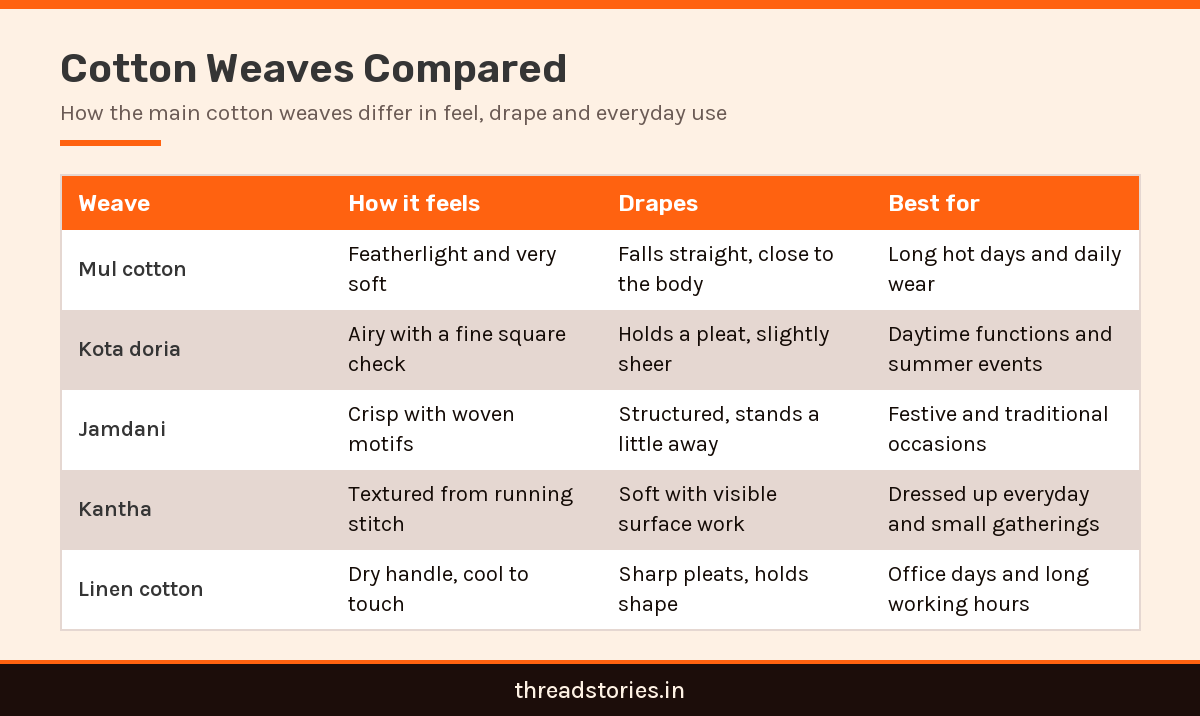
Mul is the lightest cotton in common use, woven from fine yarn into a cloth close to muslin. It weighs almost nothing, falls straight rather than holding shape, and is the most comfortable option in genuine heat. A soft mul drape is the one you reach for when the day is long and the weather is unkind. The trade off is that mul creases readily, so it suits days where you are moving rather than sitting through a formal event.
Kota doria
Kota doria comes from Rajasthan and is instantly recognisable by its fine square check, created by alternating cotton and silk yarn in the weave. The result is airy, slightly transparent and more structured than mul. It holds a pleat better, which makes the kota doria range a sensible pick for daytime functions where you want lightness without losing shape.
Jamdani and kantha
Jamdani is a supplementary weft technique where motifs are woven into the cloth rather than printed on it, a craft recognised by UNESCO for its cultural significance. It reads as festive even in plain colours. Kantha is different again, a running stitch worked over the finished cloth, which gives texture and a visible handmade quality. Both the jamdani weaves and the kantha stitched pieces sit at the dressier end of a cotton wardrobe.
Pure cotton, chanderi and linen blends
Beyond the named heritage weaves sit the workhorses. Plain pure cotton is the most straightforward drape in any wardrobe, usually in a single colour with a simple border, and it is the one most women actually wear on an ordinary week. Cotton chanderi adds a faint sheen from a silk content in the warp, which lifts it slightly above everyday without moving it into formal territory.
Linen and cotton linen blends behave differently again. They are cooler to the touch than pure cotton, they hold a sharp pleat, and they crease in a way that reads as deliberate rather than untidy. For anyone who spends the day in an office chair, that crease behaviour is the deciding factor, and it is why linen has quietly taken over a share of the working wardrobe that cotton used to own outright.
Reading Quality In A Handloom Cotton Saree
Quality in cotton is visible if you know where to look, and it has very little to do with price alone. Start with the selvedge, the finished edge running along the length of the cloth. On a hand woven piece it is firm and slightly irregular. On a power loom piece it is perfectly uniform, which sounds better and is actually the tell.
Next, hold the fabric to the light. You are looking for consistency of yarn rather than perfection. Hand spun and hand woven cotton shows tiny variations in thickness along the thread, and those variations are what give the finished drape its life. A cloth with no variation at all is almost certainly mill made.
Then check the weight against the intended use. Weight is measured in how the fabric falls rather than in grams for most buyers. Let a corner hang from your hand. If it drops straight down in a narrow line it will drape close to the body. If it holds outward it will stand away and read more formal. Neither is better, but one of them is right for what you had in mind.
Finally, look at the border join. On a good handloom the border is woven as part of the cloth, not attached afterwards. Run a finger across the join from the inside. A woven border feels continuous. A stitched border has a ridge, and that ridge will eventually fray. Details like this are why the curated cotton edit is worth browsing slowly rather than sorting by price.
One more check is worth learning, and it concerns the dye. Rub a damp white cloth gently against an inside corner of a new saree. A little colour transfer on a naturally dyed handloom is normal and settles after a few washes. Heavy transfer, or transfer that continues after several washes, points to a surface dye that was never properly fixed. That saree will keep staining blouses and petticoats for as long as you own it.
Price is the last thing to look at rather than the first. A very cheap handloom usually means either a power loom origin or a compromise in yarn count, and both show up within a year. A very expensive one is not automatically better either, because a large share of the price on some listings sits in the border work rather than the body. Judge the cloth first and let the price explain itself afterwards.
Which Cotton Saree Suits Which Occasion
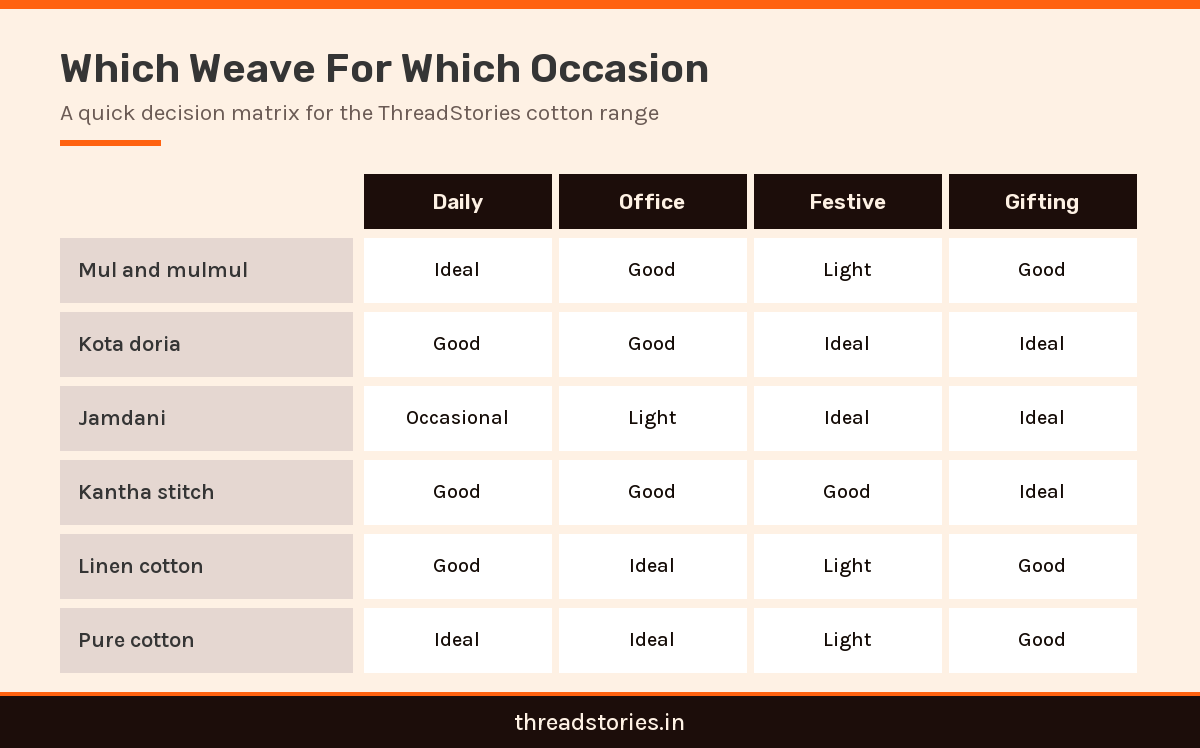
Most buying regret comes from a mismatch between weave and occasion rather than from a bad saree. A featherlight mul at a wedding reception feels underdressed. A stiff jamdani on a humid working afternoon feels like effort. Matching the two is the single most useful habit to build.
For daily wear and office days, prioritise weight and recovery. You want something that survives sitting, commuting and air conditioning without looking slept in. Linen blends and structured cottons do this best, which is why the linen threaded drapes tend to move fastest with working women.
For festive daytime, lightness and shine matter more than structure. Kota doria and lighter jamdani carry well in daylight without weighing you down through a long function. For evening and traditional occasions, move towards heavier handloom cotton or a cotton silk blend, which gives the sheen of silk with cotton comfort against the skin.
For gifting, the safest choice is a mid weight handloom in a colour the recipient already wears. Gifting a weave is generous. Gifting a colour they never choose is a shelf ornament. If you are unsure, our team is happy to talk through a pairing before you order.
Season is the other axis people forget. The same weave reads differently in April and in December. A sheer kota doria that feels merciful in peak summer feels thin at a winter evening function, and a dense kantha that is welcome in January is punishing in a Chennai June. If you own only a few cotton drapes, spread them across the calendar rather than buying three versions of the same weight.
Think about the room as well as the date. Air conditioned offices and banquet halls run cold regardless of the month, which quietly makes a mid weight handloom the most reliable choice for anything indoors and formal. Outdoor daytime events invert that completely and reward the lightest weave you own.
Pairing The Right Blouse With A Cotton Drape
A cotton saree is finished by its blouse, and the pairing rule is simpler than it looks. The blouse should either match the weight of the saree or deliberately lift it. Problems appear only when the two disagree.
With a light mul or kota doria, a structured blouse adds the shape the fabric does not have. A fitted cotton or a lightly padded blouse gives the drape an anchor. With a heavier handloom or a woven border piece, the blouse can stay simple, because the saree is already carrying the detail.
Colour follows the same logic. A plain cotton in a single shade becomes far more interesting with a contrast blouse, while a saree with a strong woven border usually looks best with a blouse pulled from a colour already in that border. If you want the full reasoning on necklines, sleeves and backs, our guide to blouse styles and fits covers it in detail.
For anyone who does not want to wait on a tailor, the ready to wear blouse range covers standard sizes in both plain and worked options. Keeping two neutral blouses on hand, one cream and one black, will carry a surprising share of a cotton wardrobe.
Fabric choice in the blouse matters as much as colour. A cotton saree paired with a synthetic blouse loses the comfort that made you choose cotton in the first place, because the blouse is the part in constant contact with the skin. Cotton, cotton silk and lightly lined options keep the whole outfit breathable. Save heavier brocade and velvet blouses for silk drapes where the weight matches.
Sleeve length is the quiet decision that changes how formal the whole look reads. A short sleeve keeps a cotton saree casual and easy. An elbow sleeve makes the same drape appropriate for a meeting or a family function without any other change. Owning one of each in a neutral shade effectively doubles the range of every cotton saree you own.
Caring For Cotton So It Softens Instead Of Wearing Out
Cotton rewards care more visibly than any other saree fabric, because the improvement is something you can feel. The goal in the first year is to soften the yarn without stressing it.
Washing
Wash a new handloom separately for the first three washes. Natural dyes release colour early and will mark anything pale sharing the bucket. Use cold water and a mild liquid detergent rather than powder, which can be abrasive on fine yarn. Never wring a cotton saree. Press the water out between your palms or against the side of the bucket, because twisting distorts the weave permanently.
Drying and storing
Dry in shade rather than direct sun. Sunlight fades natural dye quickly and makes cotton brittle over a season. Hang the saree along its length rather than folded over a line, so the weight is distributed and no single crease takes the strain. For storage, refold along a different line every month or two. A fold left untouched for a year becomes a permanent weak point, and that is where old cotton sarees eventually tear.
Ironing and reviving
Iron cotton while it is still slightly damp, on a medium setting, and work along the grain rather than across it. A completely dry handloom needs far more heat to smooth, and repeated high heat is what makes cotton go papery over time. Turn woven borders face down and press from the reverse so the zari or thread work is not flattened.
Older cotton that has gone limp can usually be revived rather than replaced. A cold soak with a spoon of rock salt helps reset the yarn, and a light rice starch restores enough body to pleat cleanly again. Sarees that have developed a permanent fold line can often be saved by cutting and rehemming a few centimetres, which is worth doing on a weave you love.
Buying Handloom Cotton Online With Confidence
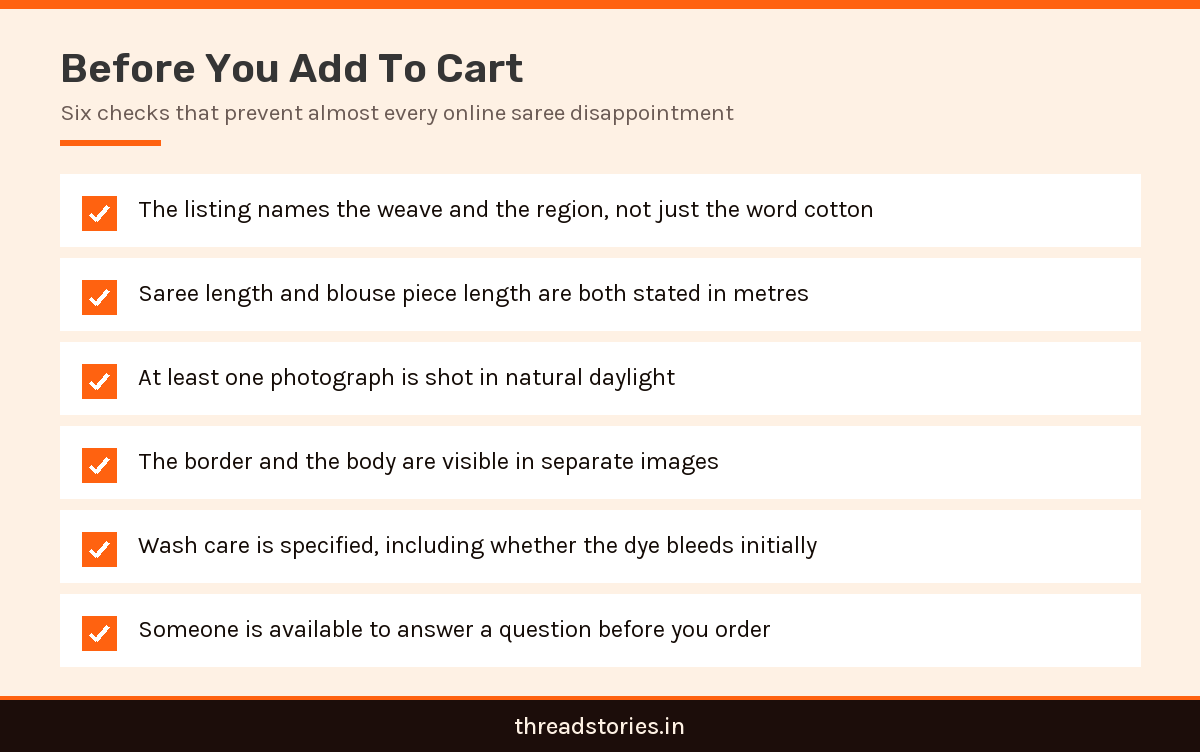
Buying cloth you cannot touch feels risky, and a few habits remove most of that risk. Start with the product description rather than the photograph. A seller who names the weave, the region and the yarn is telling you something specific. A listing that only says cotton is telling you nothing.
Read the measurements, not just the colour. Saree length varies between five and a half and six and a half metres, and blouse piece length varies more than people expect. If you are tall or you drape with extra pleats, that difference decides whether the pallu falls where you want it.
Look for images in natural light and, where possible, more than one angle. Colour on a screen shifts, and a handloom photographed under warm studio light will look different in daylight. Where a listing shows the border and the body separately, you can judge the pairing far more accurately.
Finally, buy from sellers who answer questions. The advantage of a small curated boutique over a marketplace is that someone on the other end actually knows the stock. That is the difference between buying a product and buying a piece of cloth chosen by a person.
Check the return terms before you order rather than after. Cloth is one of the categories where a reasonable returns window matters, because colour and drape are genuinely hard to judge on a screen. A seller confident in what they stock will usually say so plainly in the policy.
It also pays to order slightly ahead of when you need the saree. Allowing a week gives room for the first wash, which softens the drape and settles the dye, and for a small blouse alteration if the fit needs adjusting. Buying two days before an event removes both of those options and is the most common reason a good saree disappoints on its first outing.
Building A Cotton Wardrobe That Actually Gets Worn
A working cotton collection is smaller than most people assume. Six well chosen drapes will cover a year more comfortably than fifteen bought without a plan.
Start with two neutrals in a mid weight handloom. These are the ones you wear when you have not thought about it, and they should be in colours that pair with every blouse you own. Add two in colours you genuinely like rather than colours that photograph well, because the second category stays folded.
Then add one lightweight piece for real heat, ideally mul or kota doria, and one dressier weave for functions. That sixth piece is where a jamdani or a woven border handloom earns its place. Together those six cover commuting, working, visiting, celebrating and the occasional wedding without duplication.
Rotate them rather than protecting them. Cotton improves through use, and a saree kept for good occasions never reaches the softness that makes it a favourite. The most worn piece in a wardrobe is almost always the one that was worn early and often. If you are starting from nothing, browsing the full saree collection by weave rather than by colour is the fastest way to build that shortlist.
Petticoats and inner wear deserve a line here because they undo more outfits than any saree ever does. A petticoat in the wrong shade shows through lighter cotton, and one with a thick waistband ruins the line of a drape that falls close to the body. Keep one in cream, one in black and one in a mid grey, all in cotton, and most of the range is covered.
Finally, keep a record of what you actually wore. After one season it becomes obvious which two drapes carry the wardrobe and which colour you keep avoiding. That record is more useful than any styling advice, because it is built from your own week rather than someone else’s.
Conclusion
A cotton saree for women is not one thing, it is a family of weaves that each solve a different problem. Learn to tell mul from kota doria from jamdani and the buying decision stops being a guess. Judge quality at the selvedge and the border join, match the weave to the occasion before you look at colour, pair the blouse to the weight of the cloth, and wash gently in the first year. Explore the ThreadStories cotton collection to see these weaves side by side, and write to us if you would like help choosing your first one.
Frequently Asked Questions
Which cotton saree is best for daily wear?
A mid weight handloom or a pure cotton in a plain colour works best daily. It survives washing, holds shape through a working day and does not need special care or a dry cleaner.
What is the difference between mul and mulmul cotton?
The terms are used interchangeably in most Indian shops. Both describe a very fine, lightweight cotton close to muslin. Mulmul sometimes indicates an even softer, finer count than standard mul.
Do handloom cotton sarees shrink after washing?
Slight shrinkage in the first wash is normal and expected. Wash in cold water and dry in shade to limit it. The weave settles after two or three washes and stays stable afterwards.
How can I tell handloom cotton from power loom cotton?
Check the selvedge and the yarn. Handloom shows small irregularities in thread thickness and a firm, slightly uneven edge. Power loom cotton is perfectly uniform throughout, which is the giveaway.
Are cotton sarees suitable for weddings?
Yes, for daytime functions and smaller ceremonies. Choose a jamdani, a woven border handloom or a cotton chanderi drape rather than a plain everyday cotton.
How many cotton sarees do I actually need?
Six covers most calendars. Two neutrals, two colours you genuinely wear, one very light piece for heat and one dressier weave for functions. Rotate them rather than saving them.
Why does my cotton saree lose colour in the first wash?
Natural and vegetable dyes release surplus colour early. This is normal on genuine handloom. Wash separately for the first three washes and the bleeding stops on its own.
Should I starch a handloom cotton saree?
Light starching helps if you want crisper pleats. Use a weak rice starch rather than a commercial spray. Heavy starch stiffens the yarn and shortens the life of the weave.
What blouse works with a plain cotton saree?
A contrast or worked blouse lifts a plain drape best. Browse the Madurai sungudi and printed cotton options to see how border colour guides the pairing.
Can I wear a cotton saree in winter?
Yes, with a heavier weave and a full sleeve blouse. Kantha stitch and thicker handloom cotton hold warmth reasonably well, and a shawl handles anything colder.